

What we do
Resilience Training That Changes Lives.
A structured, experiential program that builds self-leadership, prevents destructive decisions, and restores confidence.
Hello, World!
The framework
Mission-Based Resilience (MBR).
RETI delivers Mission-Based Resilience training, adapted to each population it serves. Participants practice through simulations, exercises, and real-world application across four dimensions: physical, mental, emotional, and spiritual.
The goal is to manage stress before a crisis, perform during it, and recover quickly afterward.
25
Research-backed tools, developed by a retired U.S. Navy SEAL with a PhD
9
Years refined in the field with justice-involved participants
4
Dimensions trained as one: physical, mental, emotional, spiritual
What makes this different
Root cause, not compliance.
| Most corrections programming | RETI's approach |
|---|---|
| Entertainment, academic, or compliance-driven content | Practical application of 25 research-backed tools, developed by a retired U.S. Navy SEAL with a PhD and refined over 9 years with justice-involved participants |
| Addresses behavior, not root cause | Addresses the root cause: knowing when and how to act under pressure |
| Designed for institutional compliance, or only for post-release | Designed to be applied during incarceration and to continue post-release |
- Practical coping strategies for life's challenges
- A self-leadership mindset that turns theory into daily action
- Alignment with RETI's values: leave your ego at the door, be honest with yourself and others, make the tough decision, put purpose before self
- Direct experience preventing poor decisions through modeled scenarios
- A vision for a better future, and the tools to act on it immediately
Where we are, where we're going
Today, and 2027 and beyond.
Today
In person, in Bay County.
Four-week classes at the Bay County Jail and two-day intensives with partner agencies, delivered by the people who built the curriculum.
- Resilience for Incarcerated Adults · Class 038 completed August 2026
- Resilience for Law Enforcement & First Responders · on site
2027 and beyond
The same curriculum, delivered digitally.
MBR moves to a digital masterclass format built to reach one million justice-involved individuals by 2031.
- 2027 · Launch in first target markets
- 2028–2030 · Grow, scale and accelerate across state systems
- 2031 · Flywheel
Partner with us
Become a founding partner in scaling resilience.
Philanthropic capital is the bridge between a proven idea and a national movement. Your partnership doesn't fund an idea — it funds a future already in motion.
Now · 2026–2027
Fund the Build
Converts an established in-person program into a scalable digital asset: curriculum conversion and initial platform integration. A one-time cost that creates a sustainable model.
Next · 2028–2031
Scale What Works
Bridges the funding gap between growth-stage expansion and sustainable scale. Once that infrastructure is built, the model sustains itself.

Resilience Training That Changes Lives
A structured, experiential program designed to build self-leadership, prevent destructive decisions, and restore confidence.

The Framework
RETI delivers Mission-Based Resilience (MBR) training that equips participants with the mindset, tools, and strategies needed to navigate stress, uncertainty, and high-pressure environments.
RETI adapts this training to meet the specific needs of different populations.
Participants do not simply learn resilience—they practice it daily through simulations, exercises, and real-world application. Training challenges individuals across four integrated dimensions: physical, mental, emotional, and spiritual, preparing them to manage stress before crisis hits, navigate it when it occurs, and recover quickly after.
What Makes This Different
Most Corrections Programming
Entertainment, academic, or compliance-driven content
RETI’S APPROACH
Practical application of 25 research-backed tools, developed by a retired U.S. Navy SEAL, PhD, and refined over 9 years directly with justice-involved participants
Most Corrections Programming
Addresses behavior, not root cause
RETI’S APPROACH
Addresses the root cause: knowing when and how to act under pressure
Most Corrections Programming
Designed for institutional compliance, or only for post-release
RETI’S APPROACH
Designed to be immediately applicable during incarceration and to continue post-release
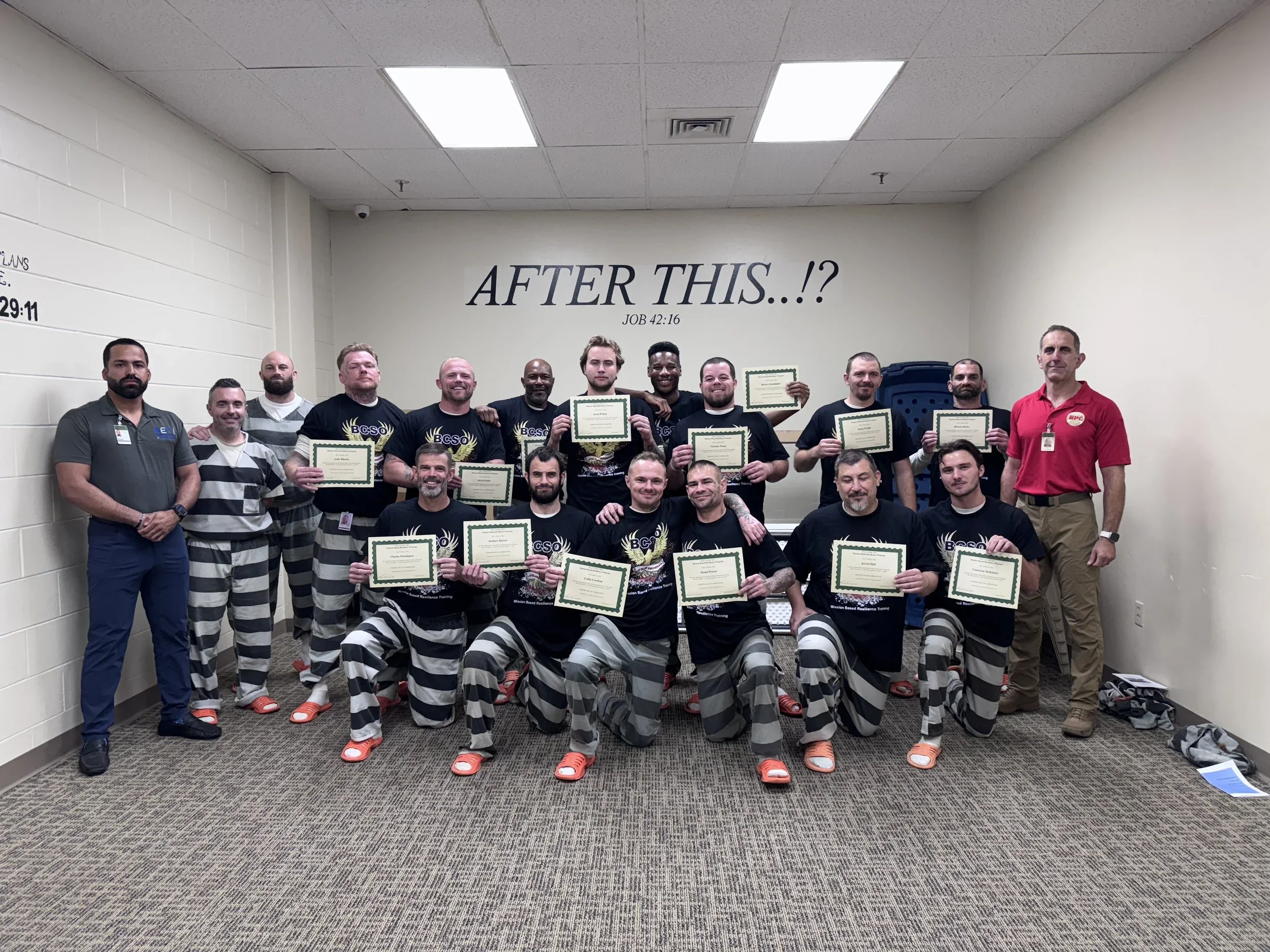
Resilience For
Incarcerated Adults
The Resilience for Incarcerated Adults Program (MBR-IA) is a four-week, in-person resilience and self-leadership program currently held at Bay County Jail in Florida.
The program serves incarcerated adults who've faced broken relationships, past mistakes, and a lack of meaningful support. MBR-IA offers a clear roadmap forward, restoring belief that success is still possible beyond past circumstances.

Resilience For Law Enforcement and First Responders
A two-day intensive resilience training designed for law enforcement officers, firefighters, EMS, and other first responders who face high-stakes decisions and cumulative stress daily.
Currently delivered on-site in Bay County, Florida. The program equips participants with practical tools to manage occupational pressure, maintain clarity under stress, and sustain performance over the long term. Participants leave with strategies they can apply immediately in the field and at home.
From Learning to Action
RETI's training is more than a curriculum—it is a lifeline in action. Participants gain:
Practical coping strategies to navigate challenges effectively
A self-leadership mindset that turns theory into daily, purposeful action
Alignment with RETI's values: leave your ego at the door, be honest with self and others, make tough decisions, and put purpose before self
Direct experience preventing poor decisions by applying strategies in realistic, modeled scenarios
Participants who once had no hope, leave with both the vision for a better future and the tools to act on it immediately